What Will Our Baby Look Like? See a Preview of Your Future Child!
Upload photos of both parents and see what your future baby — whether newborn, older, or even adult — might look like using AI.
One-time payment, no subscription
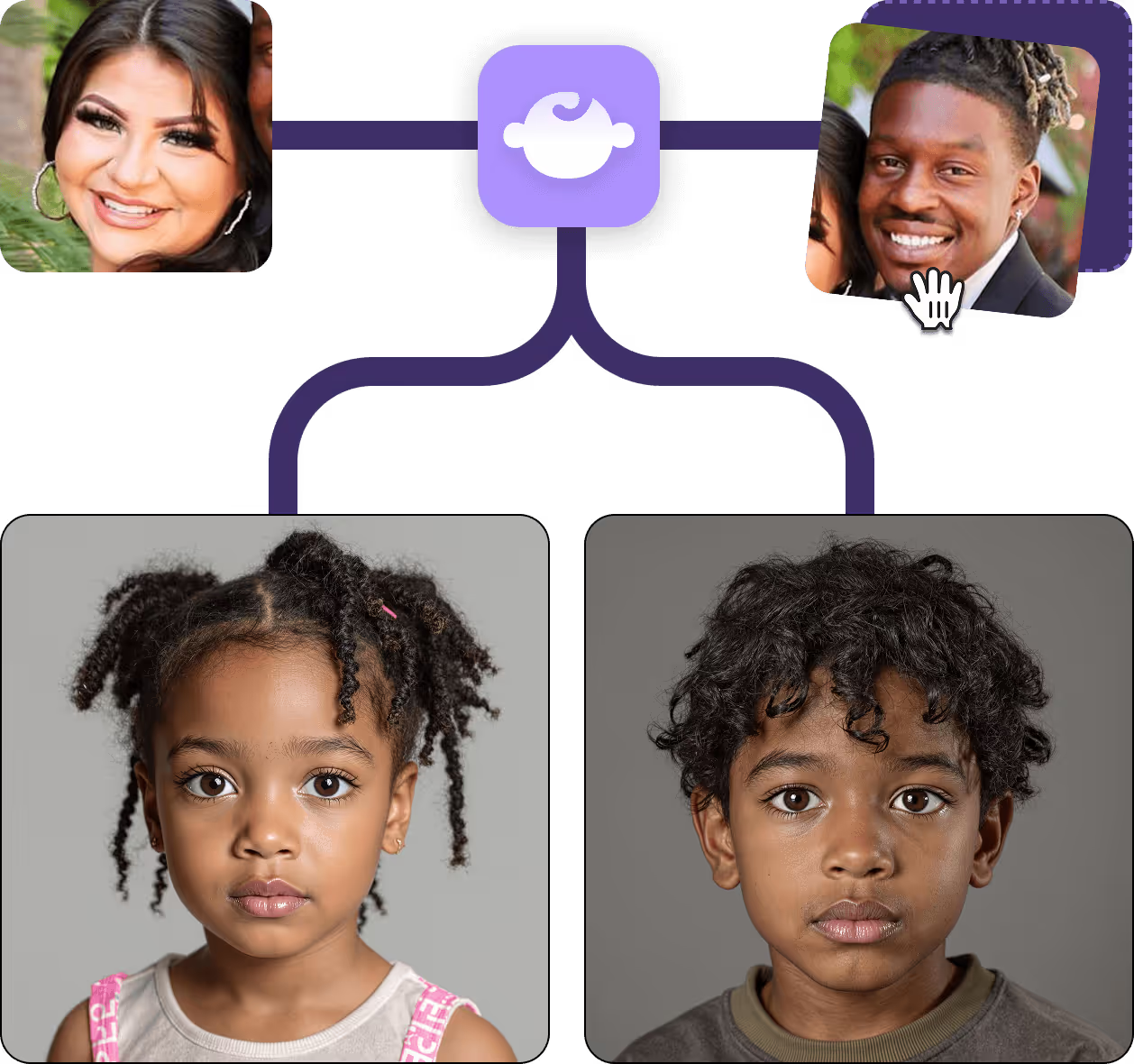
How It Works
Experience the magic of seeing what your baby will look like with our advanced AI baby generator.
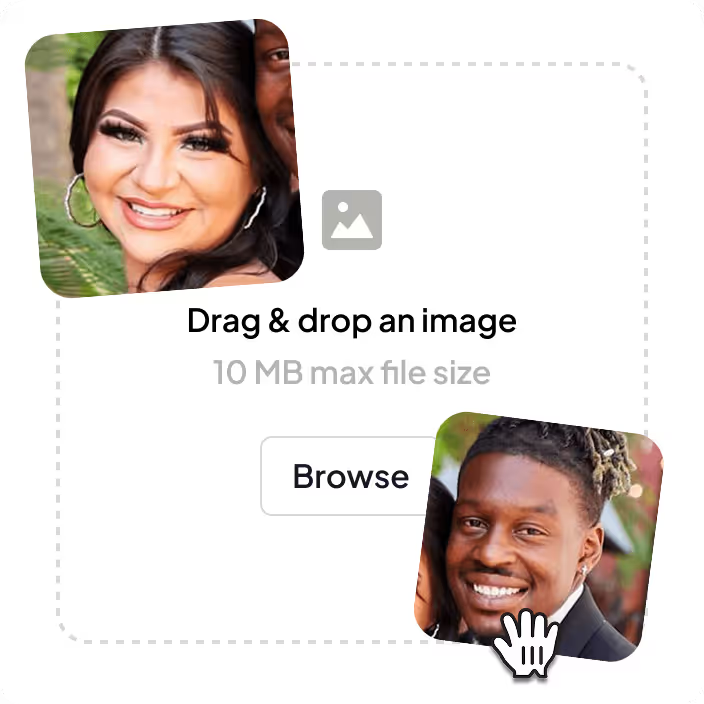
Step 1: Upload Your Photos
Simply upload photos of both parents. Our AI analyzes facial features to predict what your baby will look like with stunning accuracy.
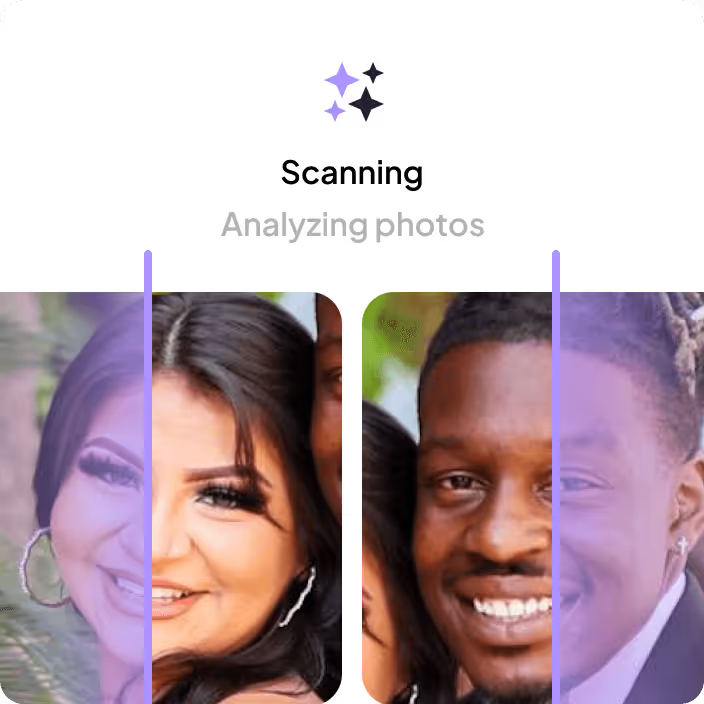
Step 2: Our AI Creates the Magic
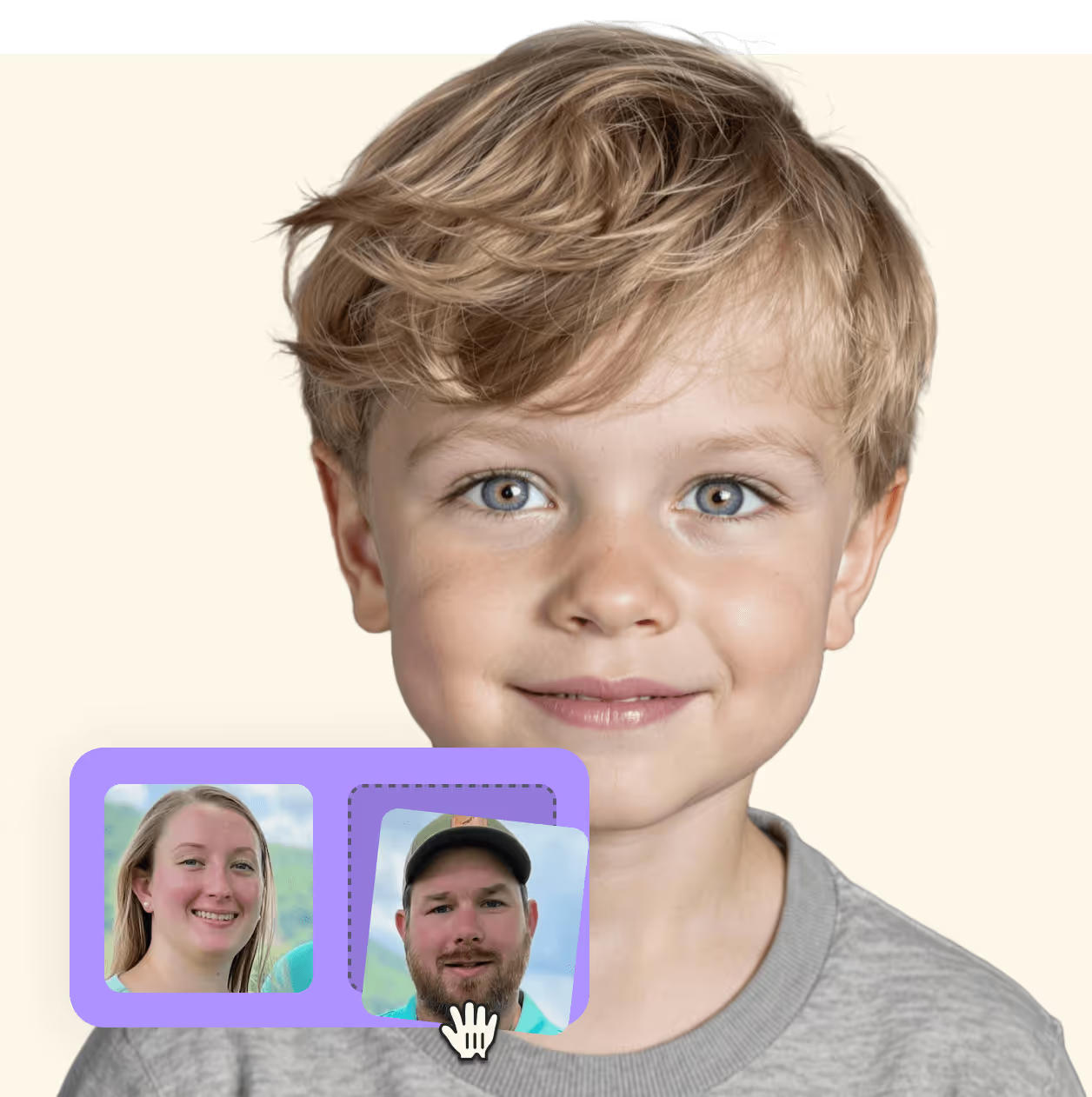
Our advanced AI combines your features to generate a realistic baby prediction in seconds. See what will your baby look like.
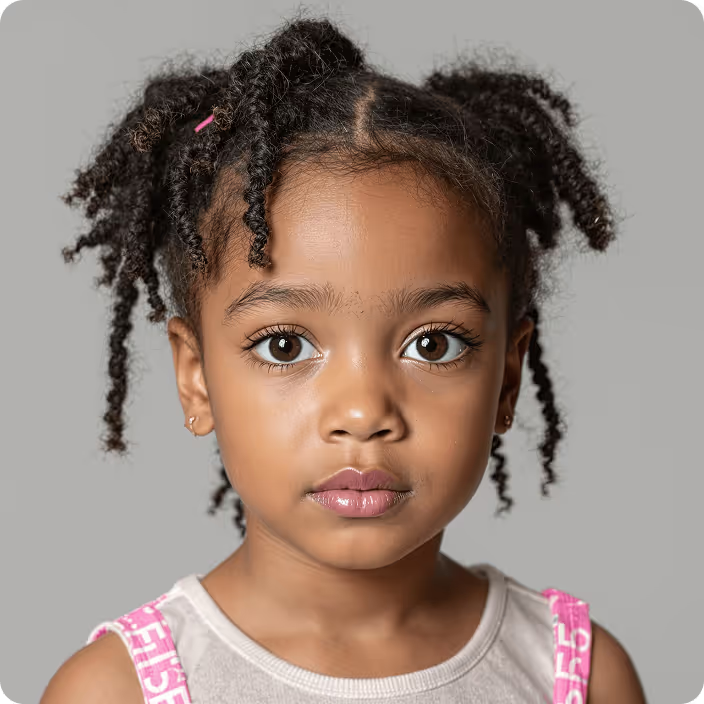
Step 3: Meet Your Future Baby
See a lifelike prediction of your future child at different ages. Share the joy with family and friends in just a few clicks!
What Actually Decides What Your Baby Will Look Like
Every visible trait your child has is settled by two copies of each gene — one from each parent — and by how those copies interact. A few traits follow the clean dominant-and-recessive pattern from school biology, and most do not. Dominant and recessive traits explains which is which, and Punnett squares shows how to work the odds for the simple ones yourself.
Eye colour is the trait people ask about first. It is mostly governed by OCA2, switched on or off by HERC2 — which is why two brown-eyed parents can have a blue-eyed child when both quietly carry the recessive variant, and why a confident single answer is the wrong shape for the question. Our baby eye colour calculator takes both parents and all four grandparents and returns the odds for each colour rather than one guess.
Hair colour works the same way, with red the most recessive of all: it needs a variant of MC1R from both sides, so two parents who are not redheads can still have a redheaded child. Skin tone behaves differently again — many genes each contribute a little, which is what polygenic inheritance means, and why a child's colouring usually lands somewhere between both parents rather than matching either.
Face shape, the nose, the jaw and the set of the eyes are polygenic too, drawing on dozens of variants from both sides. That is the honest answer to whether a baby looks more like its mother or its father: there is no mechanism that favours either parent. The research on resemblance is a story of one much-quoted 1995 finding that later studies could not replicate — perceived resemblance turns out to say more about the person looking than about the baby.
None of this is what the generator above is doing. It reads the faces in your two photos and blends them along common inheritance patterns; it cannot see a recessive trait neither of you shows, because it never sees your DNA. How AI baby generators actually work sets out the mechanism, and why they get eye colour wrong covers the trait where the gap between the genetics and the image is widest.
58,800 AI Babies Generated For 2450+ Happy Parents!
Join thousands of future parents who've already experienced the joy of seeing their future child through our AI baby generator.

Miguel & Isabella
Customers


James & Maria
Customers

Erik & Anna
Customers

Thomas & Sophie
Customers
S
Sarah
December 24, 2024
Omg this is amazing!!
Literally cant believe how good this is!! the baby looks exactly like mix of me and my hubby, we've shown it to whole family and everyone is crying.
EW
Emily W.
December 24, 2024
Pretty skeptical but IMPRESSED
Ok ngl i thought this was gonna be some scammy thing but holyyyyy these pics are INSANE. Got the premium package and its worth every penny fr.
James L.
December 24, 2024
Best money spent in my life
Wasnt sure about this at first but wow!!! My wife couldn't stop crying when she saw the pics. The baby has her nose and my eyes, its crazy accurate!!
D
David
December 24, 2024
Worth the money 100%
The elite package is expensive but trust me you want all the different ages!! We got 48 pics and each one is so different and special. Will treasure forever!
See What Your baby Will Look Like With Accurate AI Predictions
Experience the advanced AI baby generator that captures not just facial features, but the essence of your unique love story in every prediction.
High Accuracy
Our AI meticulously analyzes every facial detail, ensuring your future baby's features reflect both parents perfectly.
Almost Instant Results
Skip months of wondering and see your potential baby in minutes. The future of your family is just moments away.
Multiple Variations
Explore different possibilities of your future child at various ages, dressed differently, or in unique settings.
Private & Secure
Your parent photos stay private and are deleted automatically 30 days after you upload them. We never sell or share them, or use them to train AI.
Advanced AI Technology
Built with cutting-edge AI that understands complex genetic combinations to create hyper-realistic predictions.
100% Custom Made
Every prediction is uniquely generated from your photos – no templates, no generic results, just your future baby.
Can I See What My Baby Will Look Like for Free?
Many people look for free baby face generators. That makes sense. You want to explore without risk and without surprises.
The truth is that most free tools come with tradeoffs. Free baby generators often store photos, reuse faces to train their AI, or show ads. The results are usually low quality and can look generic or cartoon like.
Your first baby photo is free — full size, with no watermark, no account and no card. Your parent photos are kept private and deleted automatically after 30 days.
When you pay, you know exactly what you get. Clear and realistic baby photos, no hidden subscriptions, and no data reuse. Just a simple and safe way to see what your baby could look like.
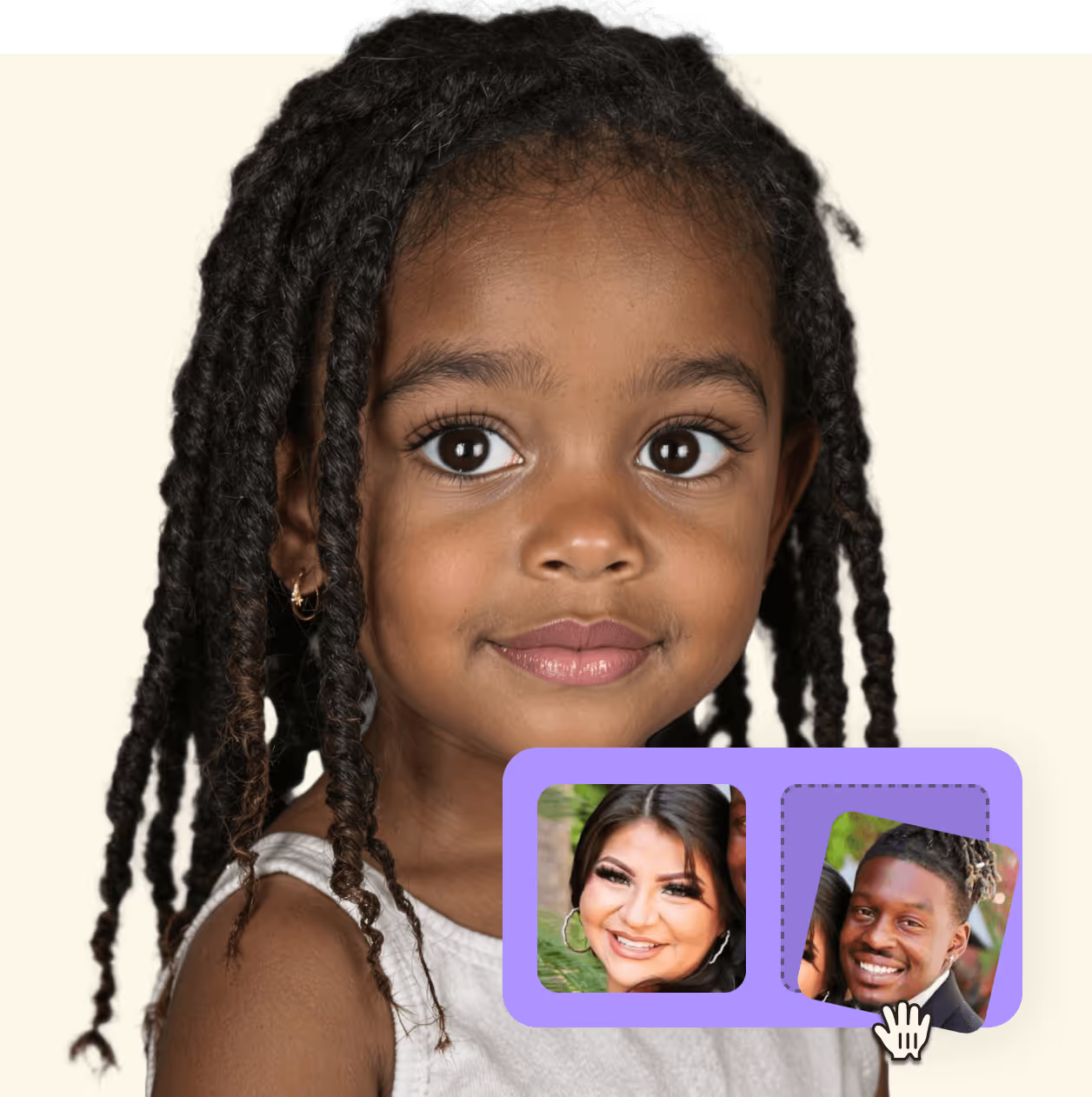
Get A Preview Of What Your Baby Will Look Like
Your first photo is free. After that, 3 more photos are $2.99 or 10 are $6.99, or as many as you like for a week for $16.99 — one-time payments, no subscription.
Your first photo
Upload both parents and meet your baby. One full-size photo, free — no watermark, no account, no card.
$0
See My Future Baby
Free, no card needed
1 full-size photo
No watermark
Girl or boy, and who they look like
Save it straight to your photos
No account needed
More photos
3 more photos for $2.99, or 10 for $6.99. Any age from newborn to 25, outfits, places, moods — and portraits with both of you.
$2.99
See My Future Baby
for 3 photos · or 10 for $6.99 · one-time
3 photos — $2.99
10 photos — $6.99
Any age, newborn to 25
Family portrait with both parents
Never expire
Studio Pass · 7 days
As many photos as you like for a week — every age, every outfit and place, and all three of you together.
$16.99
See My Future Baby
One-time payment, no subscription
Unlimited photos for 7 days
Any age, newborn to 25
Outfits, places and moods
Family portrait with both parents
Re-cast who they look like
M
Maya
December 24, 2024
Perfect anniversery gift!
Surprised my husband with this for our anniversary and he actually teared up (first time ive seen that lol). Definitely get the package with different ages!

Chris L.
December 24, 2024
A bit expensive but worth every $
Ngl the price made me hesitate but after seeing the results... just wow. Got loads of different outfits and backgrounds. processing took like 10 mins tho
L
Laura
December 24, 2024
IN LOVE WITH THIS!!
OMG THE RESULTS ARE AMAZING!! Did both genders and I cant stop looking at the pics!! I wish they had more background options but still 5/5!!!
T
Ty
December 24, 2024
Pretty cool!
Wife wanted to try this and i was like whatever but these are actually insane?? baby looks exactly like what id expect our kid to look like fr fr
Frequently Asked Questions
Everything you need to know about using our AI baby generator to see your future child. We're here to help every step of the way.
What will my baby look like?
Your baby will likely share features from both parents. This can include face shape, eyes, nose, and smile. Some traits may stand out more, while others blend softly.
No one can know the exact result before birth. Genetics are complex and include surprises. AI can help by showing a realistic preview of what your baby could look like based on both parent photos.
No one can know the exact result before birth. Genetics are complex and include surprises. AI can help by showing a realistic preview of what your baby could look like based on both parent photos.
What will my future baby look like?
Your future baby will likely look like a blend of both parents. Features such as eyes, nose, and face shape can come from either side.
AI cannot predict everything, but it can show a realistic preview by analyzing parent photos. This helps turn the question what will my future baby look like into something you can see and enjoy.
AI cannot predict everything, but it can show a realistic preview by analyzing parent photos. This helps turn the question what will my future baby look like into something you can see and enjoy.
What will my baby look like as an adult?
No one can know exactly what a baby will look like as an adult. Many features change over time, while others stay the same.
AI can create a grown up preview by following common growth patterns and facial traits. This gives you a fun and realistic look at what your baby might look like later in life, not a guarantee.
AI can create a grown up preview by following common growth patterns and facial traits. This gives you a fun and realistic look at what your baby might look like later in life, not a guarantee.
Is there a free baby generator preview?
Yes. Your first baby photo is free — full size, with no watermark, no account and no card. Upload one photo of each parent and meet your baby in under a minute.
If you want more, 3 more photos are $2.99 and 10 are $6.99 — they never expire — or a 7-day Studio Pass gives you as many photos as you like for $16.99. All one-time payments, with no subscription.
If you want more, 3 more photos are $2.99 and 10 are $6.99 — they never expire — or a 7-day Studio Pass gives you as many photos as you like for $16.99. All one-time payments, with no subscription.
How does the baby face generator work?
The baby face generator uses AI to study two parent photos. It looks at facial features like eyes, nose, mouth, and face shape.
The AI then blends these traits using common genetic patterns to create a new baby face. The result is a realistic preview, not a photo filter or simple image mix.
The AI then blends these traits using common genetic patterns to create a new baby face. The result is a realistic preview, not a photo filter or simple image mix.
How accurate is an AI baby generator?
An AI baby generator creates a realistic preview, not an exact prediction. Real genetics are complex and include hidden traits.
The AI analyzes facial features from both parents and follows common patterns. This helps create a baby image that looks natural and believable, but not guaranteed.
The AI analyzes facial features from both parents and follows common patterns. This helps create a baby image that looks natural and believable, but not guaranteed.
Does this use genetics or photos to predict my baby’s face?
The AI uses photos, not DNA or genetic tests.
It studies visible facial features from both parent photos and follows common genetic patterns. This allows the AI to create a realistic baby face preview without using real genetic data.
It studies visible facial features from both parent photos and follows common genetic patterns. This allows the AI to create a realistic baby face preview without using real genetic data.
Is this a quiz or a photo-based baby generator?
This is a photo based baby generator, not a quiz.
You upload real parent photos, and the AI studies facial features to create a realistic baby image. Quizzes use guesses and questions, while this tool uses visual data to generate the result.
You upload real parent photos, and the AI studies facial features to create a realistic baby image. Quizzes use guesses and questions, while this tool uses visual data to generate the result.
How long does it take to generate my baby’s photos?
Each photo takes about 15 seconds, and you can have up to three on the way at once.
Is my data and photo upload secure?
Yes. Photos are uploaded over an encrypted connection and kept in private storage, never on a public page.
Your parent photos are kept in private storage, used only to make your baby photos, and deleted automatically 30 days after you upload them. We never sell or share them, and we don't use them to train AI.
Your parent photos are kept in private storage, used only to make your baby photos, and deleted automatically 30 days after you upload them. We never sell or share them, and we don't use them to train AI.
What will our baby look like?
Your baby will likely be a mix of both parents. Facial features like eyes, nose, and face shape often come from each side in different ways.
While no tool can predict the future exactly, AI can create a realistic image by studying both parent photos. This gives you a clear and joyful preview of what your baby could look like.
While no tool can predict the future exactly, AI can create a realistic image by studying both parent photos. This gives you a clear and joyful preview of what your baby could look like.
What will my baby look like when older?
As your baby grows, some features stay the same while others change. Face shape, eyes, and smile often become clearer over time.
AI can show how your baby might look at different ages by adjusting facial features as they grow. This gives you a fun and realistic preview, but it is not an exact promise of the future.
AI can show how your baby might look at different ages by adjusting facial features as they grow. This gives you a fun and realistic preview, but it is not an exact promise of the future.
Can I see what my baby will look like for free?
Yes. Your first baby photo is free — full size, with no watermark, no account and no card. Upload one photo of each parent and meet your baby in under a minute.
If you want more, 3 more photos are $2.99 and 10 are $6.99 — they never expire — or a 7-day Studio Pass gives you as many photos as you like for $16.99. All one-time payments, with no subscription.
If you want more, 3 more photos are $2.99 and 10 are $6.99 — they never expire — or a 7-day Studio Pass gives you as many photos as you like for $16.99. All one-time payments, with no subscription.
Is this an AI baby generator?
Yes. PredictMyBaby is an AI baby generator.
It uses artificial intelligence to study parent photos and predict how facial features could blend in a baby. The result is a realistic baby image, not a filter or photo mix.
It uses artificial intelligence to study parent photos and predict how facial features could blend in a baby. The result is a realistic baby image, not a filter or photo mix.
Do I need to download an app to see what my baby will look like?
No. You do not need to download an app.
PredictMyBaby works directly in your browser. You can use it on your phone, tablet, or computer without installing anything or giving app permissions.
PredictMyBaby works directly in your browser. You can use it on your phone, tablet, or computer without installing anything or giving app permissions.
What affects how my baby will look?
A baby’s appearance is shaped by genetics from both parents. Features like eyes, nose, and face shape often come from each side.
Some traits are stronger, while others are softer or hidden. This is why no one can predict a baby’s exact look before birth.
Some traits are stronger, while others are softer or hidden. This is why no one can predict a baby’s exact look before birth.
Can genetics alone predict what my baby will look like?
No. Genetics are complex and do not work in a simple or exact way.
Many traits are hidden or change over time. This is why even genetics alone cannot fully predict how a baby will look. AI helps by showing a visual preview based on common patterns, but the real result can still surprise you.
Many traits are hidden or change over time. This is why even genetics alone cannot fully predict how a baby will look. AI helps by showing a visual preview based on common patterns, but the real result can still surprise you.
What photos work best for the most accurate results?
Clear, front facing photos work best. Good lighting helps the AI see facial details more clearly.
Avoid sunglasses, hats, or heavy filters. A simple background and a natural face will give the most accurate baby image.
Avoid sunglasses, hats, or heavy filters. A simple background and a natural face will give the most accurate baby image.
Will my uploaded photos be stored or reused?
Your parent photos are kept in private storage for 30 days so you can keep making photos of your baby, then deleted automatically. They are used only to make your baby photos — never sold, shared, or used to train AI.
Want them gone sooner? Email hello@predictmybaby.com and we'll delete them.
Want them gone sooner? Email hello@predictmybaby.com and we'll delete them.
What do I get after purchasing a plan?
After you purchase a plan, you can upload parent photos and generate your baby images.
You will receive clear and realistic baby photos based on your choices, like gender and age stage. There are no hidden steps or surprise charges.
You will receive clear and realistic baby photos based on your choices, like gender and age stage. There are no hidden steps or surprise charges.

Turn Your Love Story Into a Glimpse of Tomorrow With Our AI Baby Generator
One-time payment, no subscription