Why AI Baby Generators Get Eye Color Wrong
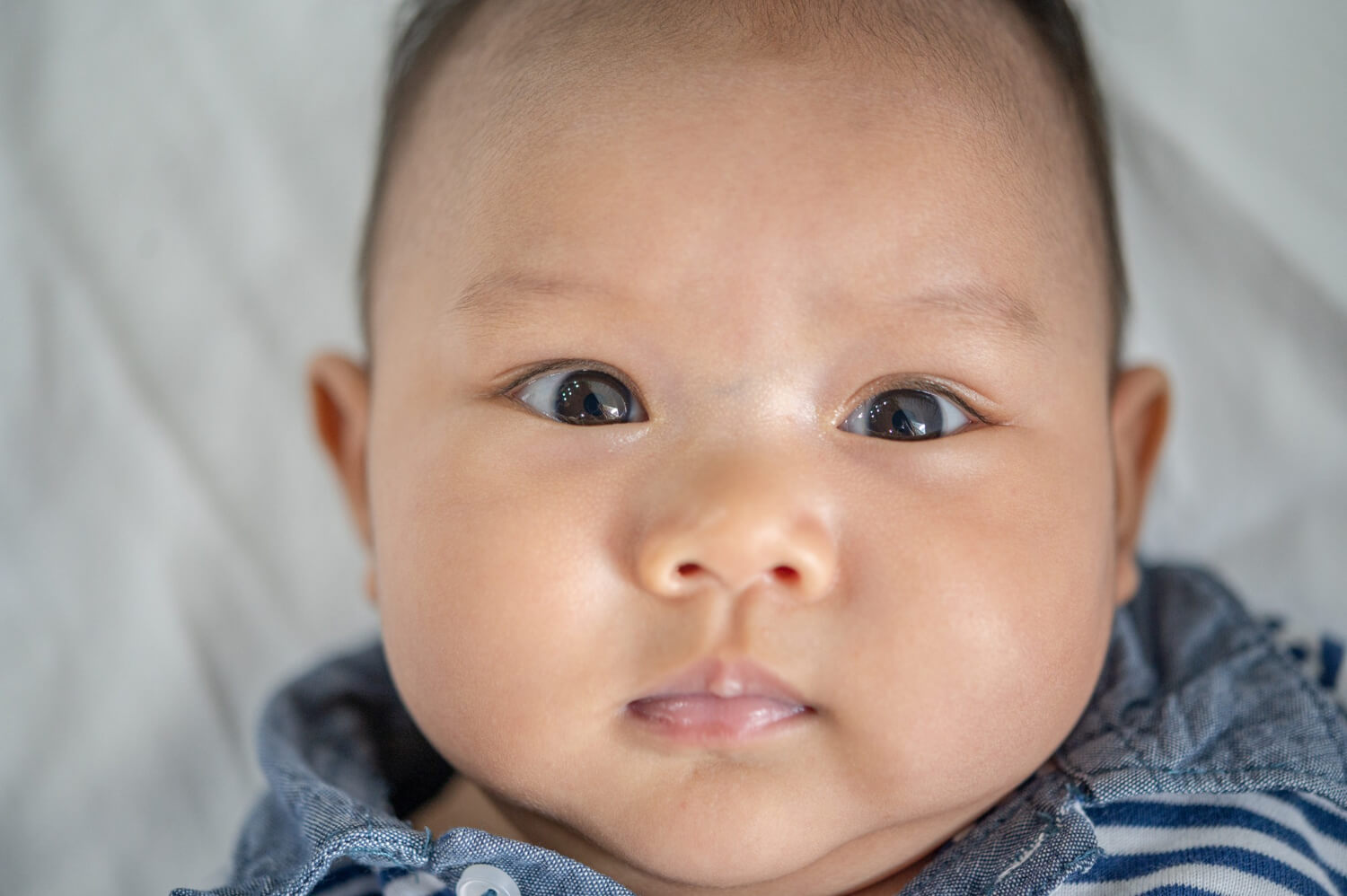
AI baby generators get eye color wrong because they read the visible colors in your two parent photos and blend them into a plausible result, rather than reading DNA. Eye color is polygenic, recessive genes can surprise you, and most newborns' eyes keep changing for months, so a photo-based guess often misses.
If you have ever uploaded your photos, seen a baby with bright blue eyes, and thought "but we both have brown eyes," you are not looking at a glitch. You are looking at the limits of what these tools actually measure. Eye color happens to be one of the trickiest traits to predict, and it is worth understanding why before you read too much into the result.
What an AI baby generator actually predicts
An AI baby generator works from pixels, not genes. It analyzes the two faces you upload, maps the facial geometry, and produces a new face that visually combines features from both parents. A modern AI baby generator like PredictMyBaby looks at more than 70 facial landmarks (the spacing of the eyes, the shape of the nose, the curve of the jaw) and blends those proportions into a believable child.
Eye color is part of that visual blend. The model sees brown eyes in one photo and green eyes in another, then renders something in between or picks one. That is image generation doing its job. What it is not doing is sequencing your genome or running a genetic probability model. If you want the full picture of how the technology works under the hood, our explainer on how AI baby generators work walks through it. The short version: these tools are visualization engines, not genetic tests.
Eye color is polygenic, not a single switch
The biggest reason eye color is hard to predict is that it does not follow the simple "brown beats blue" rule many of us learned in school. Eye color is a polygenic trait, meaning it is shaped by many genes working together, not one dominant gene flipping a switch.
According to MedlinePlus, the genetics resource from the U.S. National Library of Medicine, eye color is controlled by multiple genes, with two on chromosome 15 (OCA2 and HERC2) doing most of the heavy lifting. But "most" is not "all." Other genes such as SLC24A4, TYR, and IRF4 fine-tune the amount and type of melanin in the iris, which is why we see amber, hazel, gray, and dozens of shades of brown and green rather than two tidy categories.
Because so many genes contribute, the outcome behaves more like a gradient than a coin flip. Two parents do not simply pass down "their" color. They pass down a deck of genetic variants that get reshuffled, and the child's iris reflects the sum of that reshuffle. A photo cannot see any of those variants. It only sees the final color on each parent's face.
Recessive surprises: brown-eyed parents, blue-eyed baby
This is where the single-gene model really falls apart. Two brown-eyed parents can absolutely have a blue-eyed or green-eyed child, and it happens more often than people expect.
Here is the mechanism in plain terms: a brown-eyed parent can quietly carry "lighter eye" variants without those variants showing up in their own eyes. If both parents carry them, the child can inherit a combination that produces noticeably less iris melanin, and the eyes come out lighter than either parent's. Nothing is broken and no rule is violated. The hidden variants simply lined up.
An AI baby generator has no way to know any of this. It cannot tell that two brown-eyed parents are secretly carrying blue-eye variants, because that information lives in DNA, not in the photo. So the model will usually render brown eyes (the visible inputs), and it will quietly miss the recessive surprise that genetics allows for. The reverse happens too: a tool might render light eyes by blending one light-eyed parent's color, even when the genetic odds favored brown.
Newborn eyes change anyway
Even a perfect prediction runs into a moving target: babies' eyes are not finished at birth. Melanin keeps accumulating in the iris during the first months of life, so the color you see on day one is frequently not the color your child will keep.
The American Academy of Ophthalmology explains that a baby's eye color can keep developing as melanin builds in the iris, and the Cleveland Clinic notes that the biggest shifts usually happen between about 6 and 9 months, with many babies settling into a likely final color around their first birthday. Subtle changes can continue up to roughly age three.
It is also a myth that every baby is born with blue eyes. A newborn cohort study published in the National Library of Medicine found that about 63% of the infants had brown eyes at birth and only about 21% had blue, with the proportions shifting as the babies grew. So even if an AI baby generator nailed the newborn appearance, "newborn eye color" and "adult eye color" are often two different answers. This matters a lot for tools that show age progression: a confident blue-eyed newborn render could be a brown-eyed toddler in real life.
Visual blending vs probability: a quick comparison
The cleanest way to see the gap is to put the two approaches side by side. An AI baby generator and a genetics-based eye color calculator are answering different questions.
| Aspect | AI baby generator | Probability-based eye color tool |
|---|---|---|
| Input | Two parent photos | Parents' (and sometimes grandparents') eye colors |
| What it reads | Visible pixels, facial geometry | Reported colors used as a genetics proxy |
| How it decides eye color | Visual blend of the colors it sees | Inheritance odds across known variants |
| Output | One rendered face | A percentage chance for each color |
| Best for | Seeing a plausible face, fun and keepsakes | Estimating the odds of each eye color |
| Main weakness | Cannot detect hidden recessive variants | Cannot show you an actual face |
Neither is a genetic test. A probability tool still relies on reported colors rather than a DNA sample, so it estimates odds rather than certainty. But for the specific question of eye color, an odds-based approach is honest about uncertainty in a way that a single rendered face cannot be. If you want both the visual and the numbers, you can pair a generated face with our baby eye color calculator for a more grounded read.
How to read your AI baby's eye color sensibly
None of this means the result is worthless. It means you should read it like a stylish guess, not a forecast. A few practical habits help:
For a deeper look at how inheritance actually plays out, our guide to baby eye color genetics covers the science behind these surprises in more detail.
PredictMyBaby is upfront about this: it is a visualization tool with a one-time payment starting at $9.99, it is privacy-first (your photos are deleted after processing), and it shows your child across different ages. It is built to help you picture your future baby, not to deliver a genetic verdict on eye color. Holding it to that honest standard makes the whole experience more fun, not less.
Frequently asked questions
Why did my AI baby have blue eyes when both parents have brown?
Because the tool blends visible colors and cannot see hidden genes. Two brown-eyed parents can both carry "lighter eye" variants that do not show in their own eyes, so a real child could have blue or green eyes. The generator is rendering a plausible possibility, not predicting your specific genetics.
How accurate is AI baby generator eye color?
Eye color is one of the least reliable outputs. The tool guesses from the colors in your photos rather than from DNA, and it cannot account for recessive variants or the fact that newborn eyes keep changing. Treat the eye color as a fun estimate, and use a probability calculator for real odds.
What is the most accurate way to predict a baby's eye color?
There is no way to know for certain before birth, but a probability-based eye color calculator gives the most honest answer. It uses parents' (and ideally grandparents') eye colors to estimate the odds of each color, acknowledging uncertainty instead of committing to one rendered result.
Do real babies' eye colors change after birth?
Yes, very often. Melanin keeps building in the iris during infancy, so eyes can shift from blue or gray toward green, hazel, or brown. The biggest changes usually happen between about 6 and 9 months, with most settling near the first birthday and subtle shifts possible up to around age three.
Can an AI baby generator read my DNA?
No. It works entirely from your uploaded photos, analyzing facial geometry and visible features to render a believable child's face. It does not sequence DNA or model genetic inheritance, which is exactly why eye color (a heavily genetic trait) is the kind of detail it is most likely to miss.
Curious anyway? Try our AI baby face generator and enjoy the result for what it is: a warm, shareable glimpse, eye color footnote and all.