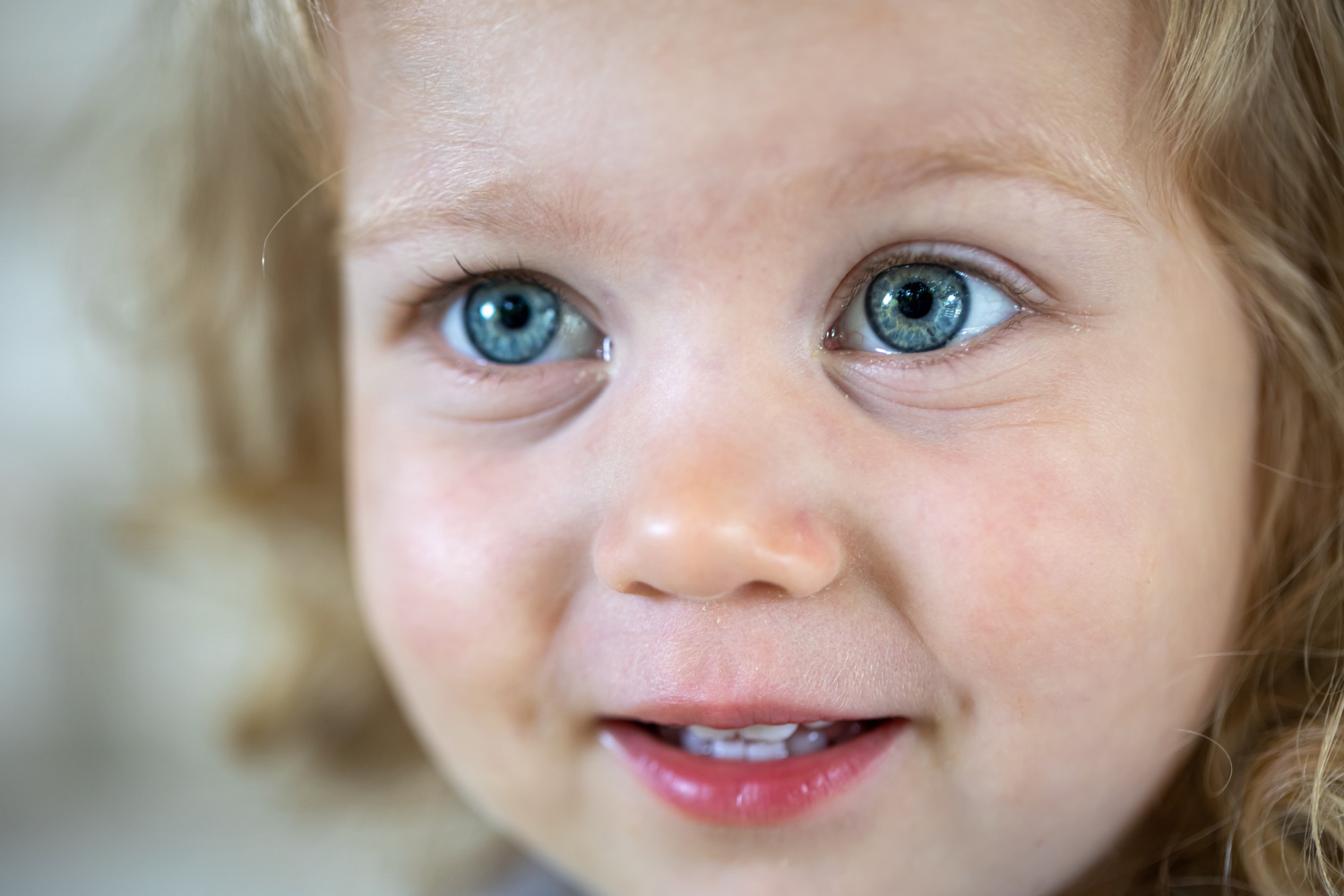
Every parent with a strong eye color opinion has wondered: will the baby get them? The honest answer from genetics is that it is more complicated than your high school biology class suggested — and far more interesting.
Baby eye color is determined by over 50 genes, with two in particular doing most of the work. Whether your baby ends up with deep brown eyes, unexpected blue ones, or the rare green that seems to skip generations depends on a chain of molecular decisions happening in the iris before your child is even born.
Here is what the science actually says — and how to make sense of the odds for your specific combination.
How Eye Color Develops: It Starts With Melanin
Eye color is not really a color at all. It is the result of how much of a pigment called melanin is present in the iris — the colored ring around the pupil — and how that amount interacts with light.
The iris contains three types of pigment that blend to produce what we see as eye color:
- Melanin — a yellow-brown pigment that also determines skin tone. More melanin = darker eyes.
- Eumelanin — a black-brown pigment. High amounts produce very dark or black-brown eyes.
- Pheomelanin — a red-orange pigment that contributes to green and hazel eyes, and is responsible for red hair.
Brown eyes have high melanin. Green and hazel eyes have moderate amounts. Blue eyes have very little pigment at all — they appear blue for the same reason the sky appears blue: light scatters, and shorter blue wavelengths reflect back more strongly. People with no melanin at all (albinism) have pale or pinkish eyes for the same optical reason.
Your baby's genes determine which proteins get produced, how actively they work, and ultimately how much melanin accumulates in the iris. That is what creates the eye color you see.
The Genes Behind It: OCA2, HERC2, and 50 Others
Scientists once thought eye color was controlled by a single dominant/recessive gene pair. That turned out to be a significant oversimplification.
A landmark 2021 study published in Science Advances that analyzed nearly 195,000 individuals identified over 50 genetic loci associated with eye color. The genetic picture is genuinely complex.
That said, two genes on chromosome 15 do the heavy lifting:
OCA2 controls the production of melanin in the iris. Variations in OCA2 are the primary reason for the spectrum from light blue to deep brown. People with low OCA2 activity produce little melanin; those with high activity produce a lot.
HERC2 sits adjacent to OCA2 and acts as a switch. A specific variant in HERC2 can turn OCA2 expression down significantly — which is why this variant is strongly associated with blue eyes. In populations where this HERC2 variant is common (Northern Europeans), blue eyes are common. Where it is rare, blue eyes are rare.
Other genes that contribute include ASIP, IRF4, SLC24A4, SLC24A5, SLC45A2, TYR, and TYRP1. These each contribute smaller effects, which is why predicting eye color from parent eye colors alone is reliable for the extremes but uncertain in the middle.
Dominant and Recessive: What It Actually Means
The classic genetics explanation still applies: brown is dominant over blue, meaning a single copy of the brown-eye allele is usually enough to produce brown eyes. Blue requires two recessive copies — one from each parent.
But "dominant" does not mean "guaranteed to show up." It means the allele tends to be expressed when present. And because eye color involves dozens of genes, not just one, the dominance picture is messier in practice:
- Brown eyes are dominant over both green and blue.
- Green eyes are recessive to brown but dominant over blue.
- Blue eyes require recessive alleles from both parents.
This is why two blue-eyed parents almost always have blue-eyed children — neither parent carries the dominant brown allele. But it is also why two brown-eyed parents can have a blue-eyed child: if both parents carry a hidden recessive blue allele (from a grandparent or great-grandparent), there is a real chance it surfaces in the next generation.
According to MedlinePlus (National Library of Medicine): "Although it is uncommon, parents with blue eyes can have children with brown eyes." The reverse — blue-eyed child from brown-eyed parents — is less rare than people expect, depending on family history.
Eye Color Probability by Parent Combination
The table below gives approximate probabilities based on established genetics research. These are estimates — the actual probability for any individual couple depends on which specific alleles each parent carries, which can only be confirmed through genetic testing.
Parent 1Parent 2BlueGreenBrownBlueBlue~99%~1%rareBlueGreen~50%~50%rareBlueBrown~50%rare~50%GreenGreen~25%~75%rareGreenBrown~12%~38%~50%BrownBrown~19%~7%~75%
A few things worth noting about this table: The brown + brown row surprises most people. Two brown-eyed parents have roughly a 1-in-5 chance of having a blue-eyed child — not rare at all. The blue + brown row is also commonly misunderstood: it is roughly 50/50, because a blue-eyed parent can only pass a recessive allele, giving the brown-eye allele a real contest.
For a probability breakdown specific to your and your partner's eye colors, PredictMyBaby's baby eye color calculator runs the genetic math and gives you the odds per color.
Newborn Eye Color: Why It Is Not Final
One of the most common surprises for new parents is that a baby's eye color at birth is not the eye color they will have at age two.
Most newborns are born before their melanin production is fully active. This means:
- White and lighter-skinned babies often appear blue or gray-eyed at birth — because there simply is not enough melanin yet to show darker colors.
- Black, Hispanic, and Asian babies are more commonly born with brown or dark eyes, because higher baseline melanin production means color is visible earlier.
Melanin production ramps up significantly in the first six months of life. Most of a baby's iris pigment develops in this window. This is why a baby who looks blue-eyed at two weeks may have distinctly brown eyes by six months.
A practical timeline:
- Birth to 3 months: Eye color is preliminary, especially in lighter-skinned babies.
- 3–6 months: Melanin production increases; color shifts become visible.
- 6–12 months: Eye color is largely stabilized for most babies.
- Up to 3 years: Subtle color shifts can continue, particularly in hazel and green ranges.
According to research published in Acta Ophthalmologica (Ludwig et al., 2016), permanent eye color cannot be reliably determined until around one year of age. The popular idea that "all babies are born with blue eyes" is also a myth: many babies, particularly those of African, Asian, and Hispanic descent, are born with brown or dark eyes that stay that way.
Green and Hazel: The Complicated Middle
Brown and blue are the most predictable eye colors. Green and hazel are harder to forecast and harder to define.
Green eyes result from a specific combination of moderate melanin levels and pheomelanin. They are the rarest common eye color globally — estimated at about 2% of the world's population, though the percentage varies significantly by region (more common in Northern and Central Europe, very rare in East Asia and Africa).
Hazel eyes are essentially a variation of brown with higher pheomelanin, producing a mixed green-brown appearance that can look different in different lighting. Both green and hazel are more likely to emerge when one parent carries OCA2/HERC2 variants associated with lighter eyes alongside other gene variants that produce intermediate melanin levels.
Will Your Baby Have Your Eye Color?
The straightforward cases:
- Both parents: brown eyes, no light-eyed relatives — very likely brown-eyed child.
- Both parents: blue eyes — almost certainly blue-eyed child.
- One brown, one blue parent — roughly 50/50, leaning slightly toward brown.
- One or both parents: green eyes — less predictable; green, hazel, blue, or brown are all possible.
The cases where genetics genuinely surprises: grandparents matter. If your brown-eyed parent had a blue-eyed parent, they may carry a recessive allele they never expressed. Red hair (MC1R gene) also influences pheomelanin and can shift eye color toward green or hazel independently. Mixed ancestry expands the range of possible outcomes further.
For a visual prediction of what your future baby might look like — including eye color, skin tone, and facial features — an AI baby generator like PredictMyBaby generates realistic AI-blended images from two parent photos. It is not a genetic test, but it gives you a realistic visual range of what your child might actually look like.
FAQ
What determines a baby's eye color?
Over 50 genes, with OCA2 and HERC2 on chromosome 15 being the most influential. These genes control melanin production in the iris. More melanin produces brown eyes; less produces green, hazel, or blue. Both parents contribute alleles, and which combination a baby inherits determines where on the spectrum their eyes land.
When can you tell a baby's true eye color?
Eye color is largely stable by 6 to 12 months of age, though subtle shifts can continue until age 3. A baby's eye color at birth — particularly in lighter-skinned babies who often appear blue or gray — is not a reliable indicator of final eye color.
Can two blue-eyed parents have a brown-eyed baby?
Rarely, but yes. Blue eyes are recessive, meaning neither parent typically carries a dominant brown allele. However, if a brown-eye allele is present from a grandparent — even if that parent shows blue eyes — it can surface in a child. Uncommon but documented.
What are the rarest eye colors?
Truly green eyes (not hazel) are among the rarest, estimated at about 2% globally. Gray eyes are also uncommon. The rarest of all is red or violet, which occurs only in albinism — the complete absence of melanin in the iris.
Can I predict my baby's eye color before birth?
You can calculate probabilities using the known genetics of each parent's eye color. PredictMyBaby's baby eye color calculator does this automatically. You cannot guarantee an exact outcome — which specific alleles get passed is determined by chance, and dozens of genes are involved.
Do brown eyes always dominate?
Brown is the most dominant common eye color — one brown allele often produces brown eyes. But with 50+ genes contributing, two brown-eyed parents still have roughly a 19% chance of a blue-eyed child if both carry recessive alleles. Dominance is a tendency, not a guarantee.
Find Out the Odds for Your Combination
If you want a prediction specific to your and your partner's eye colors, the PredictMyBaby eye color calculator gives you a probability breakdown across blue, green, and brown outcomes in seconds.
And if you want to see the full picture — what your future baby might look like, including eyes, skin tone, and face shape — our AI baby photo generator creates realistic AI-blended photos from two parent photos. Multiple variations, privately processed, deleted after use.
Try the baby eye color calculator →