Lorem ipsum dolor sit amet, consectetur adipiscing elit, sed do eiusmod tempor incididunt ut labore et dolore magna aliqua. Ut enim ad minim veniam, quis nostrud exercitation ullamco laboris nisi ut aliquip ex ea commodo consequat. Duis aute irure dolor in reprehenderit in voluptate velit esse cillum dolore eu fugiat nulla pariatur.
AI Baby Generator vs Face Filter: What's the Difference?
AI baby generators and face filters look similar but use very different technology. Learn which one creates realistic baby predictions.
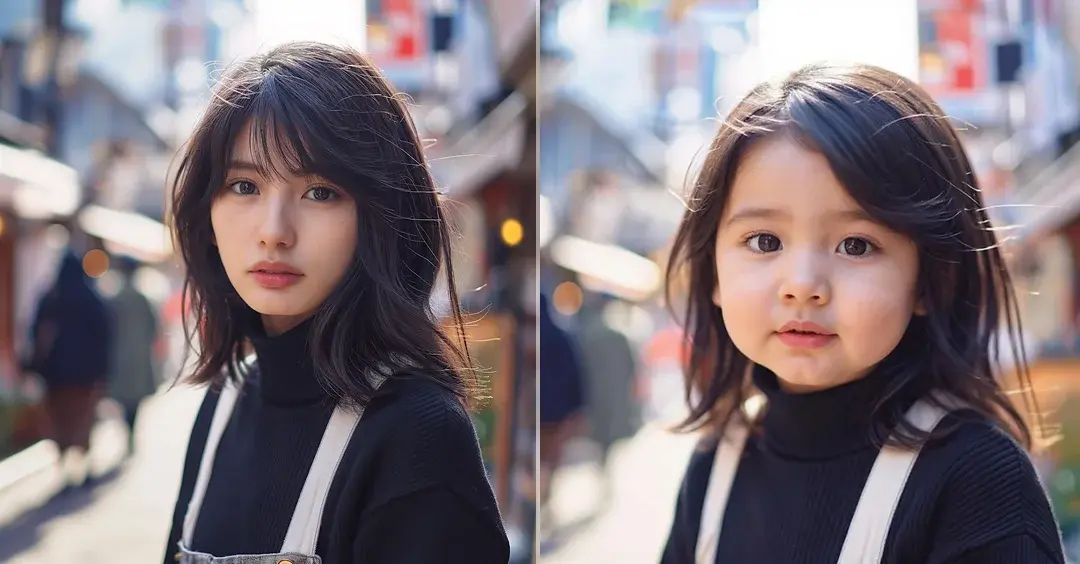
An AI baby generator creates a brand-new baby face by analyzing both parents' photos with a generative model trained on real faces. A face filter applies preset visual effects to one face, like a Snapchat baby filter that softens features and enlarges the eyes. They look similar in marketing screenshots but use fundamentally different technology and produce very different results.
This guide explains how each one works, when to use which, and why the difference matters if you want a baby photo realistic enough to keep.
Quick answer
The core distinction in one line: face filters transform one existing photo, AI baby generators create a new photo from two.
Aspect
AI baby generator
Face filter
Inputs needed
Two parent photos
One photo of any person
What it produces
A new baby face that blends both parents
The same person, modified with baby features
Technology
GAN or diffusion model trained on real faces
Geometric warping + overlays
Realism
High, looks like a real baby
Low, same adult with a filter on
Use case
Predict your future baby's appearance
Casual entertainment, social media
Result you can show family
Yes, looks plausible
Usually no, looks like a filter
If you want a result your mom will cry over, you want an AI baby generator. If you want a laugh at brunch, a face filter is fine.
How a face filter works
Face filters use a technique called facial landmark detection combined with image warping and overlays. The process:
The filter detects 68 to 468 key points on a face: corners of the eyes, edges of the lips, jaw outline, brow positions.
The filter applies a preset distortion to those points. A "baby" filter pulls the chin upward, enlarges the eyes, softens the jaw, and shrinks the nose.
Optional sticker overlays add baby-themed accessories like a bonnet or pacifier.
The result is the original person, geometrically distorted to look more infantile. The face you started with is still the face you end with. The filter just bent it.
Face filters are fast, cheap, and run on your phone with no server. They are also obviously filters. Anyone looking at the result can tell it is the same adult with a transformation applied.
How an AI baby generator works
An AI baby generator uses a generative neural network, typically a GAN (Generative Adversarial Network) or a diffusion model, trained on millions of real face images. The process:
The generator encodes each parent's face into a latent representation. This is a high-dimensional vector that captures facial features in a form the model can manipulate.
The two parent latent codes are blended, often weighted by genetic patterns the model learned during training.
An age conditioning vector pushes the blended representation toward a baby age range.
The model generates a completely new face image from the blended, age-conditioned representation.
The output is not a transformation of either parent. It is a new face that did not exist before, generated to look like a plausible blend of the two parents at a baby age. The technology behind this is the same family that powers face generation tools like StyleGAN.
You want a quick 5-second laugh on TikTok or Instagram
You only have one person's photo
You do not care if it looks like a filter
You want it free with zero friction
Use an AI baby generator when:
You want to see what your actual future baby might look like
You have photos of both parents
You want a result good enough to share with family or save as a keepsake
You want options like different ages, genders, or settings
You care about getting a result that blends both parents' features realistically
For curious couples, expectant parents, gender reveals, and gifts, an AI baby generator is the right tool. For casual fun, a face filter does the job.
Why the difference matters for keepsake-quality photos
Customers often tell us they tried a free baby filter first, did not love the result, and went looking for something more realistic. The reason: face filters produce something that looks like a filter. They are entertaining for a moment but do not feel like a real prediction.
AI baby generators produce a result that looks like a photograph of a real baby. When the generation is good, the response from family is usually emotional. The baby has features from both parents, looks plausible, and could pass as a real photo of a child you have not had yet. That is a fundamentally different category of output from a face filter.
If you want the latter, try the AI baby generator at PredictMyBaby for hyper-realistic results. We use a GAN-based model that produces hyper-realistic blends with full age progression from newborn to adult.
Common confusion: "AI face filters"
Some tools market themselves as "AI face filters" or "AI baby filters." These are a hybrid: face filters with some machine learning involved in the landmark detection or the cosmetic adjustment. They are technically more sophisticated than pure geometric filters but still operate on the same one-photo, transform-don't-generate paradigm.
A good test: if the tool asks for one photo and outputs a baby version of that person, it is a filter, regardless of marketing language. If the tool asks for two photos and outputs a baby that is neither parent but looks like both, it is a generator.
What to look for in a real AI baby generator
If you want the generator path, here is what to check:
Asks for two photos (one of each parent)
Produces a face that does not look like either parent specifically but resembles both
Offers multiple result variations so you can see different possible outcomes
Has a clear technology explanation (GAN, diffusion, neural network, generative AI)
Realistic baby texture (skin, eyes, hair look like a real baby, not a stylized cartoon)
Optional features like age progression, gender selection, or background variations
Tools that do all of these are generators. Tools that ask for one photo and apply a "baby effect" are filters dressed up in different marketing.
Frequently asked questions
Is an AI baby generator just a fancy face filter?
No. A face filter transforms an existing photo of one person. An AI baby generator creates a new face from two parent photos using a generative neural network. The underlying technology is fundamentally different.
Can a face filter predict what my baby will look like?
Not accurately. A face filter applies preset baby features to whichever photo you upload. It does not blend two parents or generate a new face. The output is the original person with a baby filter on top, not a prediction.
Are AI baby generators more accurate than face filters?
Yes, when the generator is well-trained. A GAN-based AI baby generator analyzes both parents and produces a plausible blended result. A face filter does not blend parents and is not designed for prediction. For predicting baby appearance, AI baby generators are the clear winner.
Why do AI baby generators cost money when face filters are free?
AI baby generators run computationally expensive neural networks on GPUs in the cloud, which has real per-use cost. Face filters use lightweight geometric transformations that run on your phone. The cost difference reflects the technology difference.
Can I use a free AI baby generator?
Yes, several free options exist. Quality varies a lot. Free generators sometimes compensate for the cost of running the AI with ads, mandatory accounts, or photo retention for model training. Always check the privacy policy of any free tool before uploading.
Which is better for a gender reveal party: filter or generator?
An AI baby generator, by a wide margin. The result is realistic enough to print on a card or display on a screen and feels like a real prediction. A face filter result usually looks like a filter and does not have the same emotional weight.
Curious about your future baby? See your future baby with both parent photos and see a hyper-realistic prediction in minutes.